Workshop: Design Patterns For AI Products In 2026
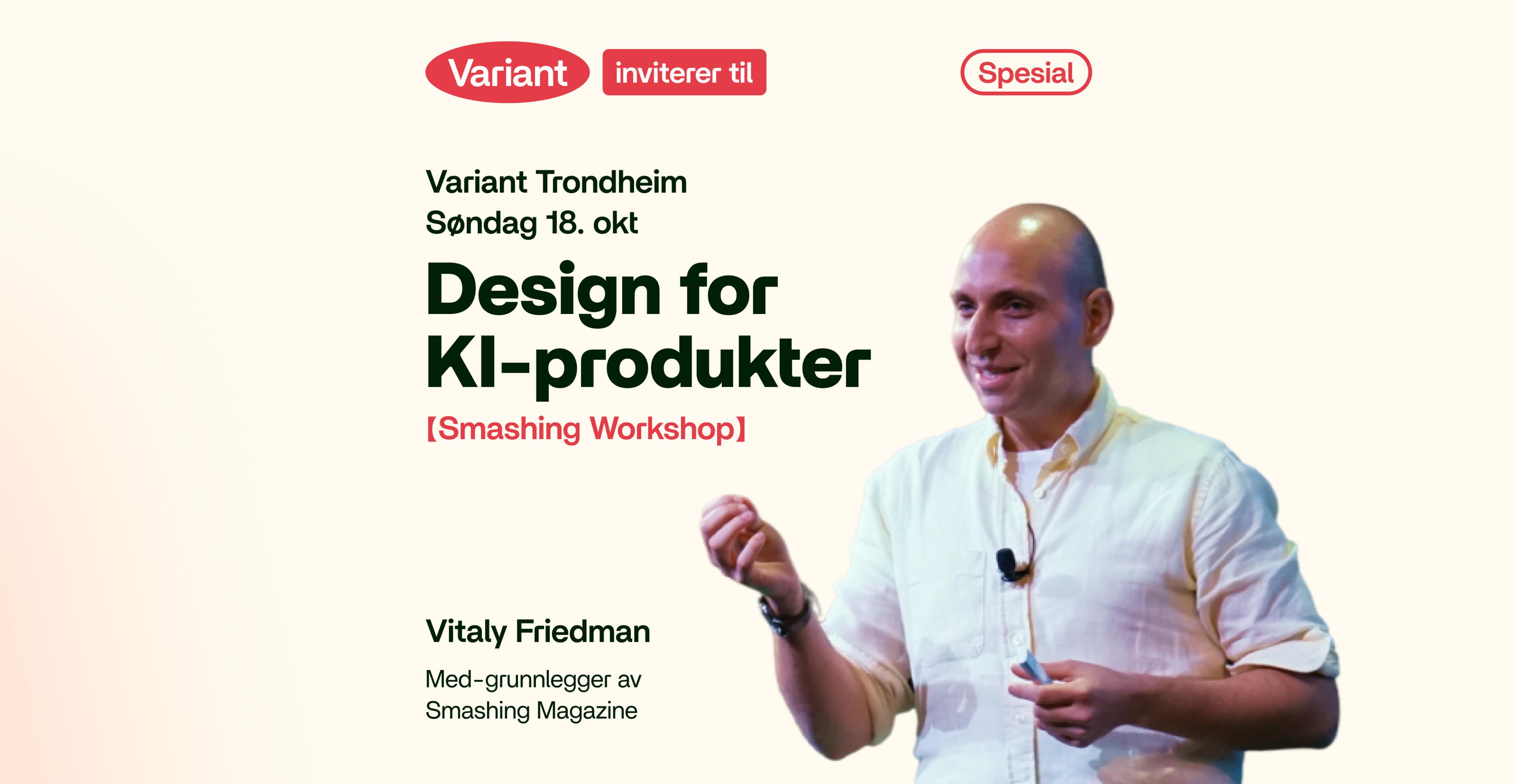
Vitaly Friedman has spent 20 years helping product teams create digital experiences people actually use. As creative lead of Smashing Magazine and UX advisor to the European Parliament, he has seen first-hand what works – and what doesn't.
On October 18th, he has set aside a full day with us at Varianthuset in Trondheim. After the workshop, you can join this year's mingle party for curious developers and designers, with food, drinks and a quiz at ✨Bariant ✨ This is free for those you with a ticket.
PS! We can reveal that Vitaly is a speaker at this year's TDC 🤩
Workshop outline
As product teams race to integrate AI in their products, they quickly realize that users don’t perceive AI particularly well. Too often AI features are painfully verbose, their responses are generic, their insights have subtle hallucinations sprinkled all over them, and users have to ping-pong between prompts, over and over again. Plus, there is very little trust and confidence in the quality of AI outcomes. Well, let’s fix that!
In this full-day workshop we’ll explore technical constraints and limitations and emerging design patterns for remarkable AI experiences that people actually understand, value and perhaps even fall in love with.
We’ll explore how we can help users get work done better and faster – with better context engineering, designing for building and maintaining trust, applying the right guardrails at the right time for the right tasks and use plenty of emerging design patterns like style lenses, prompt constructors and feedback knobs.
Bonus: We’ll also explore how to adapt design systems to be AI-friendly and how to adjust the workflow to produce better AI-powered results.
In the workshop, we’ll cover:
The State of AI UX in 2026
- What is AI capable of today, and what should we as designers and engineers understand about AI accuracy and AI capabilities to create compelling AI experiences.
- New UX research on how people discover and use AI features, and why many AI features have poor adoption and poor retention rates.
- How people work with and around AI features, with main slowdowns, blockers, usability and (often overlooked) severe accessibility issues.
- AI constraints and limitations that we, as designers and engineers should be aware of.
Design Patterns For AI Products
- Context engineering and how to design and build for it, along with agentic AI, memory.
- Quiet AI vs. Visible AI, prompt strength indicator, daemons, modifiers, task builder, forced ranking, style lenses, precision knobs.
- Design patterns for building trust, navigating AI output, proactive AI, presets, pre-prompts, capability awareness, context engineering.
- How to reduce high interaction cost of prompt engineering, context awareness, capability awareness and AI discoverability.
Boosting AI UX In Complex Products
- Where AI typically lives and how to help people provide better input, make sense of AI output and refine it to match user's needs well.
- How to support decision-making and complex workflows – with guardrails, permissions, approval flows and human in the loop.
- How to find a balance between overreliance and aversion with AI features to minimize the chance of irreversible critical mistakes.
Designing For Trust and Confidence
- Design strategies that build confidence and clarity around AI behaviors and decisions.
- How limited transparency, better reasoning traces, consensus meters and transparency increase retention of AI features.
- How to signal and label AI-generated content, and make it work with human-written, curated content.
Real-Life Case Studies
- How to design AI features and experiences from scratch – with AI Design Canvas, from data collection to gathering feedback.
- How companies design and implement AI features in their products, where they fail and succeed.
- How to bring AI into the product, from data collection and data cleansing to designing AI loops and user flows.
- Agentic UX – how to support decision-making and complex workflows – with guardrails, permissions, approvals and human in the loop.
- How teams measure the quality of AI UX and how valuable and reliable AI features actually are for end users.
How will it work?
We’ll be starting off by exploring things we’ve learned about AI so far, practical design patterns and plenty of practical examples of AI products – successful and not. Then, for a given task, we’ll be breaking into groups and designing (and reviewing) AI experiences on paper.
Participants will leave the workshop with a toolbox of practical techniques and design patterns to apply to your current or upcoming projects right away. Most importantly, you will learn how to use AI as a new material, its constraints and limitations, product challenges and how to apply design patterns to make the most out of AI-enhanced products.
Who is this workshop for?
This workshop is for open-minded front-end engineers and product designers who’d love to learn how to make sense of AI and create AI experiences that people understand, value and trust.
Vitaly says: "Roll up your sleeves and have your coffee ready: I would like to make this day worth your time – it will be quite a journey, and we’ll jump right in with both feet!"
Meetup: Framsia
Nyheter i JavaScript + TDD i frontend + Arkitekturen gjorde React gøy
Development
Front End
Workshop: Design Patterns For AI Products In 2026
Variant invites you to workshop with Smashing Magazine's Vitaly Friedman the day before TDC, and offers an inspiring day followed by good food and drinks.
Design
AI